Research Frontiers in Autonomous Intelligence
NexToro conducts foundational research with a clear trajectory toward system-level intelligence.
When research outcomes demonstrate stability, repeatability, and safety, they are engineered into deployable systems — and, where appropriate, productized in collaboration with institutions and industry partners.

Autonomous Intelligence Systems
Intelligence that sustains coherent behavior as conditions refuse to stay still.
What This Area Explores
We research systems that sustain coherent behavior as conditions evolve — carrying context forward and acting without continuous supervision.
Why It Matters Now
Static AI systems fail in dynamic, high-stakes environments
Human-in-the-loop does not scale with complexity
Autonomy requires governance, not just prediction
What Becomes Possible
Systems that remain coherent as conditions evolve
Decisions that carry context forward, not just react
Autonomy that operates within constraints, not prompts
Current Status
🟢 Active research
🟡 Controlled experimental evaluation
Autonomous Intelligence Systems
Intelligence that sustains coherent behavior as conditions refuse to stay still.
What This Area Explores
We research systems that sustain coherent behavior as conditions evolve — carrying context forward and acting without continuous supervision.
Why It Matters Now
Static AI systems fail in dynamic, high-stakes environments
Human-in-the-loop does not scale with complexity
Autonomy requires governance, not just prediction
What Becomes Possible
Systems that remain coherent as conditions evolve
Decisions that carry context forward, not just react
Autonomy that operates within constraints, not prompts
Current Status
🟢 Active research
🟡 Controlled experimental evaluation
Autonomous Intelligence Systems
Intelligence that sustains coherent behavior as conditions refuse to stay still.
What This Area Explores
We research systems that sustain coherent behavior as conditions evolve — carrying context forward and acting without continuous supervision.
Why It Matters Now
Static AI systems fail in dynamic, high-stakes environments
Human-in-the-loop does not scale with complexity
Autonomy requires governance, not just prediction
What Becomes Possible
Systems that remain coherent as conditions evolve
Decisions that carry context forward, not just react
Autonomy that operates within constraints, not prompts
Current Status
🟢 Active research
🟡 Controlled experimental evaluation

Regime Intelligence & Dynamic Environments
Intelligence that recognizes when the rules of the environment have changed.
What This Area Explores
We study how intelligence remains effective when the structure of the environment itself changes.
Why It Matters Now
Most models assume stationarity
Real-world systems are non-linear and discontinuous
Failure to adapt causes cascading errors
What Becomes Possible
Earlier awareness of systemic change
Reduced cascading errors during transitions
Decision continuity across unstable conditions
Current Status
🟢 Active research
🟡 Controlled experimental evaluation
Regime Intelligence & Dynamic Environments
Intelligence that recognizes when the rules of the environment have changed.
What This Area Explores
We study how intelligence remains effective when the structure of the environment itself changes.
Why It Matters Now
Most models assume stationarity
Real-world systems are non-linear and discontinuous
Failure to adapt causes cascading errors
What Becomes Possible
Earlier awareness of systemic change
Reduced cascading errors during transitions
Decision continuity across unstable conditions
Current Status
🟢 Active research
🟡 Controlled experimental evaluation
Regime Intelligence & Dynamic Environments
Intelligence that recognizes when the rules of the environment have changed.
What This Area Explores
We study how intelligence remains effective when the structure of the environment itself changes.
Why It Matters Now
Most models assume stationarity
Real-world systems are non-linear and discontinuous
Failure to adapt causes cascading errors
What Becomes Possible
Earlier awareness of systemic change
Reduced cascading errors during transitions
Decision continuity across unstable conditions
Current Status
🟢 Active research
🟡 Controlled experimental evaluation

Multi-Agent & Swarm Architectures
Intelligence that emerges from interaction rather than central control.
What This Area Explores
We explore how intelligence can emerge from interaction — without relying on a single decision-maker.
Why It Matters Now
Centralized intelligence does not scale
Swarm systems offer resilience and flexibility
Coordination ≠ communication
What Becomes Possible
Intelligence that survives partial failure
Adaptation through cooperation, not instruction
Emergent behavior without explicit scripting
Current Status
🟢 Active research
🟡 Controlled experimental evaluation
Multi-Agent & Swarm Architectures
Intelligence that emerges from interaction rather than central control.
What This Area Explores
We explore how intelligence can emerge from interaction — without relying on a single decision-maker.
Why It Matters Now
Centralized intelligence does not scale
Swarm systems offer resilience and flexibility
Coordination ≠ communication
What Becomes Possible
Intelligence that survives partial failure
Adaptation through cooperation, not instruction
Emergent behavior without explicit scripting
Current Status
🟢 Active research
🟡 Controlled experimental evaluation
Multi-Agent & Swarm Architectures
Intelligence that emerges from interaction rather than central control.
What This Area Explores
We explore how intelligence can emerge from interaction — without relying on a single decision-maker.
Why It Matters Now
Centralized intelligence does not scale
Swarm systems offer resilience and flexibility
Coordination ≠ communication
What Becomes Possible
Intelligence that survives partial failure
Adaptation through cooperation, not instruction
Emergent behavior without explicit scripting
Current Status
🟢 Active research
🟡 Controlled experimental evaluation

Mathematical Signal Discovery
Intelligence grounded in discovering structure before fitting models.
What This Area Explores
We investigate the structure that precedes labels, supervision, and surface-level correlations.
Why It Matters Now
Feature engineering limits intelligence
Patterns exist outside labeled data
Mathematical structure precedes learning
What Becomes Possible
Earlier detection of meaningful patterns
Reduced dependence on surface-level correlations
Stronger foundations for downstream decisions
Current Status
🟢 Active research
🟡 Controlled experimental evaluation
Mathematical Signal Discovery
Intelligence grounded in discovering structure before fitting models.
What This Area Explores
We investigate the structure that precedes labels, supervision, and surface-level correlations.
Why It Matters Now
Feature engineering limits intelligence
Patterns exist outside labeled data
Mathematical structure precedes learning
What Becomes Possible
Earlier detection of meaningful patterns
Reduced dependence on surface-level correlations
Stronger foundations for downstream decisions
Current Status
🟢 Active research
🟡 Controlled experimental evaluation
Mathematical Signal Discovery
Intelligence grounded in discovering structure before fitting models.
What This Area Explores
We investigate the structure that precedes labels, supervision, and surface-level correlations.
Why It Matters Now
Feature engineering limits intelligence
Patterns exist outside labeled data
Mathematical structure precedes learning
What Becomes Possible
Earlier detection of meaningful patterns
Reduced dependence on surface-level correlations
Stronger foundations for downstream decisions
Current Status
🟢 Active research
🟡 Controlled experimental evaluation

Decision Systems for High-Stakes Domains
Intelligence designed for decisions that cannot be undone.
What This Area Explores
We focus on decision systems where failure is costly, irreversible, or systemic.
Why It Matters Now
AI is moving into operational control
Decisions must be auditable and bounded
Safety requires structure, not prompts
What Becomes Possible
Decisions that remain bounded under pressure
Greater transparency into consequence chains
Systems designed to fail gracefully
Current Status
🟢 Active research
🟡 Controlled experimental evaluation
Decision Systems for High-Stakes Domains
Intelligence designed for decisions that cannot be undone.
What This Area Explores
We focus on decision systems where failure is costly, irreversible, or systemic.
Why It Matters Now
AI is moving into operational control
Decisions must be auditable and bounded
Safety requires structure, not prompts
What Becomes Possible
Decisions that remain bounded under pressure
Greater transparency into consequence chains
Systems designed to fail gracefully
Current Status
🟢 Active research
🟡 Controlled experimental evaluation
Decision Systems for High-Stakes Domains
Intelligence designed for decisions that cannot be undone.
What This Area Explores
We focus on decision systems where failure is costly, irreversible, or systemic.
Why It Matters Now
AI is moving into operational control
Decisions must be auditable and bounded
Safety requires structure, not prompts
What Becomes Possible
Decisions that remain bounded under pressure
Greater transparency into consequence chains
Systems designed to fail gracefully
Current Status
🟢 Active research
🟡 Controlled experimental evaluation
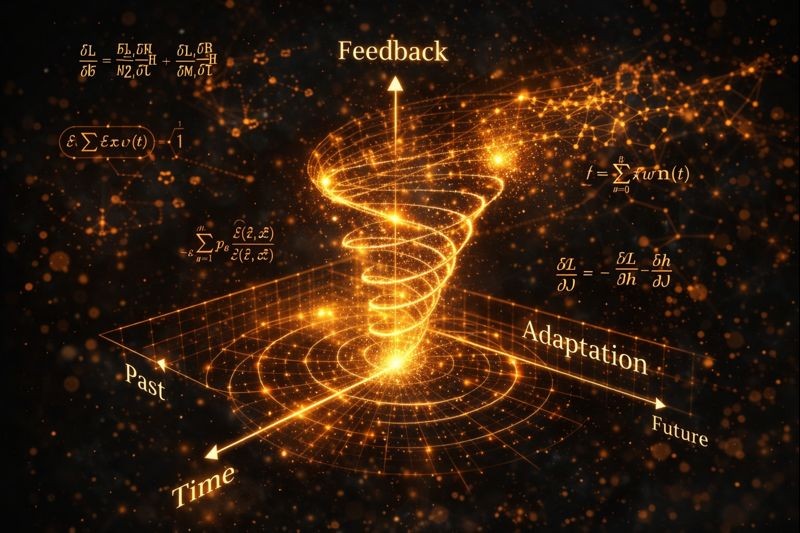
Temporal Learning & Adaptive Systems
Intelligence that evolves through experience, not retraining cycles.
What This Area Explores
We study learning systems whose behavior improves through operation, not repeated retraining.
Why It Matters Now
Static training creates brittle systems
Real intelligence accumulates experience
Memory ≠ storage
What Becomes Possible
Systems that improve through operation
Learning is aligned with long-term behavior
Adaptation without constant retraining
Current Status
🟢 Active research
🟡 Controlled experimental evaluation
Temporal Learning & Adaptive Systems
Intelligence that evolves through experience, not retraining cycles.
What This Area Explores
We study learning systems whose behavior improves through operation, not repeated retraining.
Why It Matters Now
Static training creates brittle systems
Real intelligence accumulates experience
Memory ≠ storage
What Becomes Possible
Systems that improve through operation
Learning is aligned with long-term behavior
Adaptation without constant retraining
Current Status
🟢 Active research
🟡 Controlled experimental evaluation
Temporal Learning & Adaptive Systems
Intelligence that evolves through experience, not retraining cycles.
What This Area Explores
We study learning systems whose behavior improves through operation, not repeated retraining.
Why It Matters Now
Static training creates brittle systems
Real intelligence accumulates experience
Memory ≠ storage
What Becomes Possible
Systems that improve through operation
Learning is aligned with long-term behavior
Adaptation without constant retraining
Current Status
🟢 Active research
🟡 Controlled experimental evaluation